
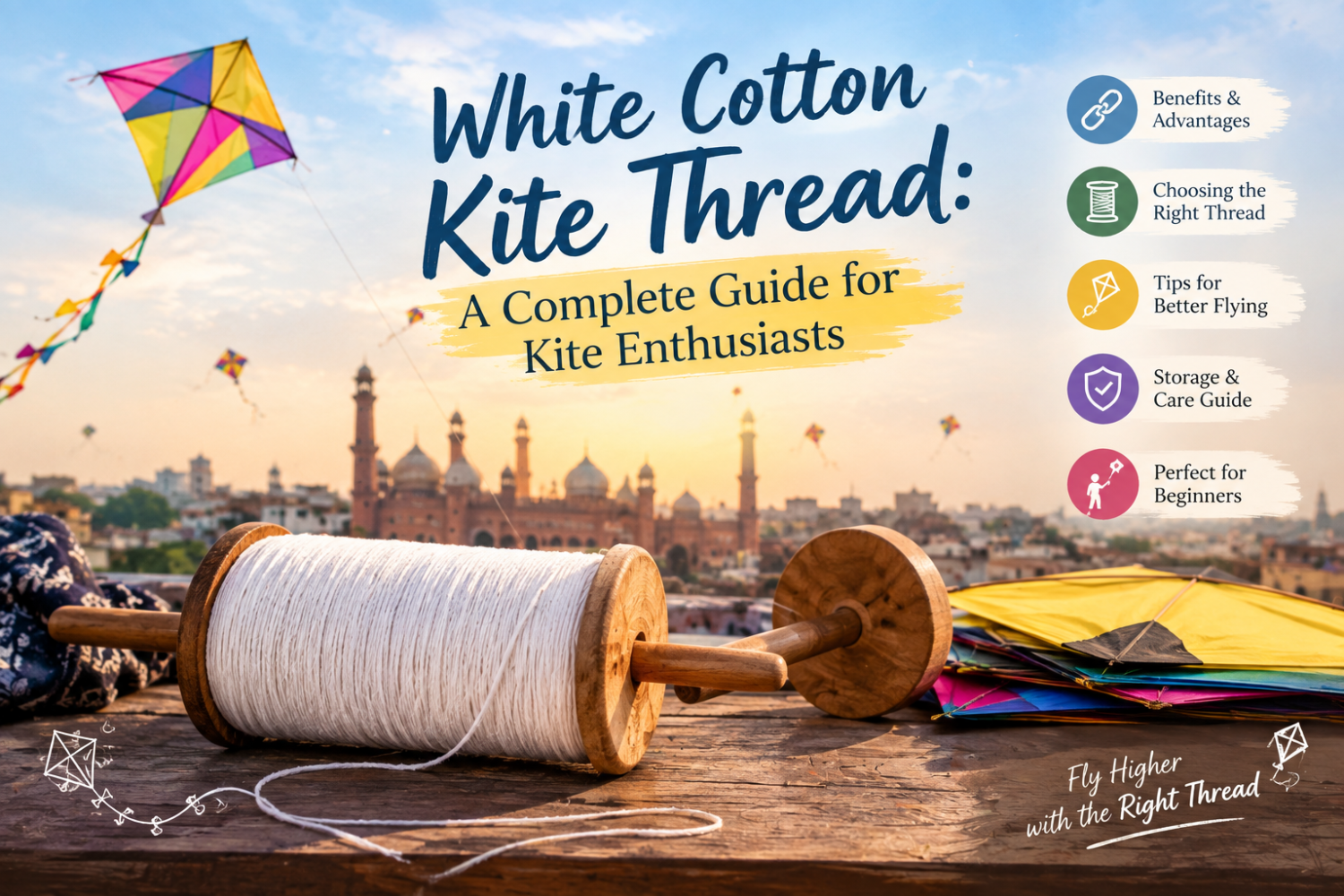
White Cotton Kite Thread: A Complete Guide for Kite Enthusiasts
A good kite setup depends on more than the kite itself. The thread also plays an important role in handling, storage, and the overall flying experience. Among the different options available, White Cotton Kite Thread remains a familiar choice for people who prefer a simple, traditional, and easy-to-understand setup.
Cotton-based thread is commonly associated with traditional kite products because of its natural fiber construction and straightforward appearance. It also works well with accessories such as a Thread Spool or charkhi, which helps keep the thread organized.
For customers shopping online, different names such as Cotton Thread, White Thread, White Cotton Thread, and Kite Flying Thread can sometimes create confusion. Although these terms are related, they do not always describe exactly the same product.
This guide explains what these terms mean, what buyers should check before purchasing, and how a suitable thread and spool can become part of a well-organized kite setup.
What Is White Cotton Kite Thread?
White Cotton Kite Thread is a cotton-based thread produced or sold for kite-flying use and supplied in a white finish.
The name itself gives the buyer three useful details: the material is cotton, the color is white, and the intended purpose is related to kite flying.
This is more informative than a product being listed simply as “thread.” When shopping online, specific product names help customers understand what they are looking at before they even open the full description.
A clear title also makes it easier to compare different products within the same category.
Why Cotton Thread Is a Familiar Choice
Cotton Thread has a long association with traditional kite products. Cotton is a natural fiber, and thread made from it has a familiar texture and appearance.
Another reason cotton-based options are easy to understand is that they can be offered in different lengths, thicknesses, cord or ply variations, and packaging styles.
Rather than choosing a product only because it is described as “premium,” it is better to check practical specifications.
Useful details may include:
Material
Thread length
Cord or ply information
Spool size
Packaging
Product category
Recommended purpose
Clear specifications make it easier for customers to compare products without relying on marketing language alone.
Understanding White Thread
White Thread mainly describes the color of a product.
It does not automatically tell the buyer what material the thread is made from. A white thread could be cotton or another fiber unless the product details confirm otherwise.
The white color has a clean and simple appearance, which is one reason it is commonly used in product photography.
For online shops, white thread can be presented clearly against a suitable background, allowing customers to see the shape of the spool, thread texture, and packaging.
Still, color should never be the only detail used to describe a product. Material, quantity, and intended use should also be mentioned.
White Cotton Thread vs Regular White Thread
The terms White Cotton Thread and White Thread may look similar, but they are not always interchangeable.
White Cotton Thread tells the buyer both the material and the color. White Thread only confirms the color unless another specification explains the fiber type.
This is why product naming matters.
For example:
“White Cotton Kite Thread” gives the customer more useful information than a title such as “White Thread.”
When categories are organized properly, customers can also understand the difference between different product options more quickly.
What Is Kite Flying Thread?
Kite Flying Thread refers to thread that is specifically presented or manufactured for kite-flying use.
This makes it different from ordinary thread that may be intended for sewing, crafts, packaging, or general household purposes.
A kite-related product page should clearly explain whether the thread is meant for recreational kite use and should include relevant specifications.
A simple product description is often more useful than exaggerated claims.
For example, customers usually benefit more from knowing the thread material, length, spool type, and cord information than from reading phrases such as “ultimate thread” or “best in the world.”
The Role of a Thread Spool
A Thread Spool helps keep thread properly wound and organized.
Without a spool, loose thread can become difficult to store and may tangle with other accessories.
Different spool sizes are available depending on the quantity of thread being stored. Smaller spools may suit limited quantities, while larger reels can hold longer lengths.
Some products are sold with thread already wound onto a spool, while others allow the customer to buy the spool and thread separately.
For online buyers, a product page should clearly state whether the spool is included.
Choosing a Suitable Thread Spool
Selecting a spool should be based on the amount of thread and the type of setup being organized.
A useful online listing can provide:
Spool dimensions
Thread capacity
Material of the spool
Product weight
Whether handles are included
Packaging details
Multiple-angle product photos are also helpful.
A customer should be able to see the front, side, and overall shape of the spool before placing an order.
This makes the product page feel more complete and reduces confusion.
Understanding Cord and Ply Options
Some thread products are categorized using cord or ply numbers.
These numbers are useful for distinguishing between product variations, but they should not be treated as the only factor when comparing threads.
Customers should also consider the material, length, manufacturer details, spool size, and intended use.
For online stores, cord or ply information should be displayed in a visible area such as the product title, specification table, or short description.
This prevents customers from having to search through a long paragraph just to find an important detail.
Product Quality and Clear Information
A good product listing should focus on information customers can actually verify.
Instead of repeatedly using words such as “strong,” “premium,” or “professional,” the page should explain the product itself.
For example, a useful description can mention:
Cotton construction
White finish
Thread length
Spool type
Product dimensions
Packaging quantity
Available variations
This kind of content feels more natural and trustworthy.
It also helps buyers make decisions based on real product details.
What to Check Before Buying Online
When buying White Cotton Kite Thread online, customers should review the full listing rather than looking only at the product title.
The first thing to confirm is the material.
Next, check whether the quantity or thread length is mentioned.
Cord or ply details should also be visible when they apply to that product.
If a Thread Spool is included, the listing should show its size and design.
Packaging details are also useful, especially for customers ordering multiple products.
Finally, the product photographs should match the description and show the actual variation being sold.
Why Product Photography Matters
Thread and spool products can look very similar in text, so photography becomes especially important.
A clean product image should show:
The complete spool
Thread color
Product label
Spool shape
Important packaging details
Using the same photography style across different thread products also makes a website look more organized.
For example, if every spool is photographed from the same four angles, customers can compare different colors or variations more easily.
The product should remain the main focus of the image without unnecessary decorative elements.
Storing Cotton Kite Thread
Proper storage helps keep thread neat and easier to manage.
Cotton thread should remain properly wound on its spool when it is not being used.
The spool can be kept in a clean and dry storage area away from unnecessary moisture and dust.
Loose sections of thread should not be mixed with other accessories because they can become tangled.
A simple storage box, kite bag, or dedicated shelf can keep thread, spools, and other kite-related products organized in one place.
Why Product Names Matter Online
A strong product name should immediately explain what the customer is viewing.
For example:
White Cotton Kite Thread
This name tells the customer the color, material, and category.
By comparison, titles such as “Best White Thread” are less informative.
Clear naming also improves website navigation.
A customer may browse through separate categories such as Cotton Thread, White Thread, White Cotton Thread, Kite Flying Thread, and Thread Spool without becoming confused about what each section contains.
Traditional Kite Products in Modern Online Stores
Kite products were traditionally purchased from local markets and specialist shops where customers could inspect products in person.
Online shopping has changed this experience.
Today, customers rely more heavily on product images, titles, specifications, descriptions, and category organization.
Because of this, traditional products need to be presented in a modern way.
An online store can make the shopping process easier by organizing products into clear categories and providing enough information on every page.
A customer should be able to move from kites to thread, then to spools and accessories without getting lost.
Building a Complete Kite Product Collection
For an online kite shop, it can be useful to organize products as part of a complete collection instead of treating each item separately.
For example, a customer browsing kites may also need a suitable thread option and a spool.
Related categories can include:
Paper kites
Cotton-based kite thread
White thread options
Spools and charkhis
Kite bags
Storage accessories
Showing related products can make the website easier to use while also helping customers understand how different products fit together.
Frequently Asked Questions
1. What is White Cotton Kite Thread?
White Cotton Kite Thread is a white cotton-based thread sold or presented specifically for kite-flying use.
2. Is Cotton Thread different from White Cotton Thread?
Yes. Cotton Thread describes the material, while White Cotton Thread tells the customer both the material and the color.
3. What is a Thread Spool used for?
A Thread Spool keeps the thread wound, organized, and easier to store.
4. What does Kite Flying Thread mean?
Kite Flying Thread refers to thread intended or marketed for recreational kite-flying use rather than ordinary household purposes.
5. What should I check before buying kite thread online?
Check the material, color, length or quantity, cord or ply information, spool details, packaging, and product photographs.
Conclusion
White Cotton Kite Thread remains a recognizable option within traditional kite products because it combines a familiar cotton material with a simple white appearance.
Understanding the difference between Cotton Thread, White Thread, White Cotton Thread, Kite Flying Thread, and a Thread Spool helps customers compare products more easily.
For an online store, clear information matters just as much as the product itself. Accurate names, practical specifications, consistent photography, organized categories, and straightforward descriptions can make the buying process easier and more professional.
Instead of repeating the same claims across every section, a useful kite-thread guide should answer real customer questions, explain product differences, and help buyers understand what they are choosing.